http://prestidigitator420.wordpress.com/
Tuesday, October 22, 2013
Thursday, August 8, 2013
The Theseus Paradox
"Ship of Theseus” is one of the finest movies I have seen in recent times. An intense and thought-provoking narration of three different stories that beautifully converge towards the end to represent the Theseus' paradox.
For the ignorant: "The ship of Theseus, also known as Theseus' paradox, is a paradox that raises the question of whether an object which has had all its components replaced remains fundamentally the same object. The paradox is most notably recorded by Plutarch in Life of Theseus from the late 1st century. Plutarch asked whether a ship which was restored by replacing all and every of its wooden parts remained the same ship." (Source: Wikipedia)
Now the paradox could raise several questions. First of all is it the same ship? If not, then at what point would you call it a different ship? When 50% of its components are replaced? Or 100%? Or 10%? To arrive at any such number we would need to understand-What in fact constitutes a ship?
As I was discussing this with a friend, I made the following argument:
When it comes to humans, the 'brain' is the key, without which everything else is pretty much useless. As long as the brain remains intact, any number of body part replacements will not change the person in any way. But if the brain is replaced (hypothetically), then the person becomes someone else. So I set "brain" as a limit beyond which the person no longer remains the same. I mean, have you ever seen a person change after a kidney transplant?
But then what about those instances where the human body rejects an external organ when tried to be transplanted? It does happen often. Is it because the external organ will make the person – someone else?
In response, my friend brought up a very interesting point of view:
“Brain in a jar” or “Brain in a vat” as it is commonly known. Essentially, every action, reaction and emotion of a human is store in the brain. Experiments have shown that when the brain is given tiny electric shocks, memories stored in those specific areas are triggered and the person experiences the memory as if it were really happening at that very instant. What if we were all just experiencing such a phenomenon where our brains are in reality store in a jar and someone is controlling them with electric shocks? This means that the life that we are leading is nothing but past events that have already happened in our lives and are re-surfacing now.
Difficult to conceptualize? Try this – when you are in a dream, doesn’t it feel like it is completely real? Till the time you wake up, you think that you are actually living the dream. So a brain in a jar is like a never ending dream. Only difference - in an actual dream, the events are fictional whereas over hear, the events are past recollections.
I do have an alternate theory to this:
The world we live in is itself virtual. A mere simulation, by superior beings who are playing some sort of a video game in which we are characters. Just like how one would control characters in a game of World of Warcraft or Halo. We humans are the characters of a very large video game controlled by superior species. Moreover, what we think is our ‘free will’ is in fact the free will of the being who is our controller.
Story 1:
A young girl loses her vision to an infection. Despite the blindness, she becomes an ace photographer. Later on, she gets a cornea replacement and gains her sight back. However, her photography skills are now no longer the same as it used to be earlier.
So what actually happened here? Having someone else’s cornea changes her skill-set. She is no longer the same person she used to be. Remember the ship?
However, one thing was not very clear in the movie. Whether the girl already a good photographer before she turned blind or was it a skill set she developed only after she turned blind? In the first case, the ship theory is applicable. However, in the second case her talent in photography is directly correlated to her blindness and the cornea replacement simply reiterated the fact. The movie did not answer this issue clearly.
Story 2:
A monk is fighting a PIL against pharmaceutical companies on the issue of cruelty to animals. The monk believes in Karma and Destiny and in the equality of living beings. This is in contrast to his ardent disciple who belongs to the Charvak school of thought which essentially rejects the concept of an afterlife and advocates hedonism. Throughout this story, we are exposed to a lot of heavy philosophy on the purpose of existence, identity, and death in the form of healthy debating between the monk and his disciple. In a twist of fate, the monk contracts cirrhosis, the treatment for which will entail a liver transplant and medicines from the very same companies he is fighting against. Caught between ethics and survival, what does the monk finally do?
This story shows how a simple event such as ‘death’ makes a person go through a whole lot of identity crisis. Death – is an equalizer in many ways. When faced by it, nearly every person would possibly react in the same manner. Overwhelmed by fear, unpreparedness and a desperate desire to get out of it. Because this is a phenomenon one gets to experience only once in a lifetime and hence no prior experience in handling it. In the end, the monk decides to give up every single thing he stood for his entire life and embrace the very medicines he was fighting against, simply because he could not face death.
Story 3:
A workaholic stock broker is constantly nagged by his grandmother to go out, enjoy life, and try to contribute something meaningful to society.
Their conversations go thus:
“What is the use of earning all the money when you are not contributing anything back to the society?” “If I am a hardworking, sincere guy who does have enough compassion in him to help a fellow human when in need, but otherwise is focused only on earning money, why is it wrong?”
Hard to dismiss such an argument. The guy is certainly shown to have concern and empathy when his grandmother was sick and bed ridden. What is then wrong to focus one’s life on material pursuits otherwise? What more is required? Does one necessarily have to take extra initiatives on ‘contributing’ to society?
The story continues:
The stockbroker gets a kidney transplant and later comes to know that the hospital is involved in a kidney stealing racket. Suspecting that his kidney may be a stolen one, he investigates. He finds out that the kidney of a certain labourer was stolen and donated to a rich Swedish chap. He makes it a personal agenda to get justice done to the victim and goes to Stockholm to confront the guy. What finally happens is that the Swedish guy buys out the labourer with so much money that the man is no longer interested in fighting back for his kidney and the stockbroker remains helpless
The question now arises – is money the only thing that drives the world? The stock broker could have afforded to go legal, but can the poor man do the same? What made the broker go out of his way to help a poor man? A new kidney? Given that his mission was ultimately unsuccessful, should he have even attempted it? To this, the grandmother says “Bas itna hi hota hai”.
Don’t expect anything more, but you do what you have to do. Just like what the Bhagwad gita says – “Karm karo, phal ki chinta mat karo” or “Perform your duty, don’t worry about its results”.
The story ends when it is revealed that all of the three transplants – cornea, liver, and kidney had come from the same person, an unfortunate accident victim.
All the characters in each of the stories transformed in various ways as certain events changed the way they looked at life. The environment changed, they were out of their comfort zones. At what point does this change exactly happen?
I shall end this post with a quote from the movie that aptly describes this conundrum.
Thursday, September 6, 2012
September rain - Revisited
Did you hear? The traffic towards Kurla has come to a standstill. There is heavy water logging and vehicles are just stuck. How do you plan to go home?
Really? Oh no. Let me think over it.
Another 3km to go. From hereon, the road was full of vehicles with barely any space in-between for pedestrians to walk through. The traffic had come to a stand-still.
The traffic was only on one side of the road cos the water-logging on the other side was so bad that it was impossible for vehicles, even trucks and SUVs to ply through that.
The entire 3km stretch till my house was flooded, with just the depth of water varying between 1 and 3 feet.
As I walked along, I decided to make the best of the situation and started clicking photographs of whatever I saw, so that I could post them up on a blog post that I would write later :)
I did have an umbrella with me but it was pretty useless. I was anyway half drenched from the dirty muddy ground water. Besides in a situation where one has to squeeze through vehicles in the jam packed road, it was not even possible to keep the umbrella open. I really didn't mind getting drenched though. The more important issue here was to ensure I don't fall into a pit or a pothole.
Always carry your smartphone with a camera that has flash during monsoons in Mumbai. An umbrella may not always be required, but a good cameraphone is a must.
Postscript:
#mumbairains was the top trending keyword on twitter for that evening. Continuous updates on traffic situation across the city and emergency helpline contact numbers were tweeted.
Sunday, March 18, 2012
Windsurfing
Monday, June 27, 2011
DRS in Cricket...
However, the BCCI was against this system and therefore the DRS was not made mandatory across all forms of International cricket tournaments, given the clout BCCI holds in the cricket arena. Notwithstanding the fact that DRS was more beneficial than not to cricket (opinions here may differ vastly though), BCCI still is not in favor of DRS in its entirety, especially given that the opposition was from key players like Sachin Tendulkar and MS Dhoni. Ironically, Dhoni was the one who even recently in the WI tour lambasted the 'poor' decisions of Australian umpire Daryl Harper. Oh come on Dhoni, give it a break; you can't have it both ways! Either you accept DRS or you stop criticizing umpires.
Coming back to the present scenario - today's news is that the ICC and BCCI have reached an agreement to have a 'modified' version of DRS mandatory in all International series.
Now this is 'modified' version:
1: Only infra-red cameras and audio-tracking devices are allowed
2: Ball-tracking technology or Hawk-Eye will NOT be used
In case 1: A caught behind or LBW decision can be reviewed by determining whether or not the ball hit the bat - primarily using the help of microphone on the stumps.
In case 2: Technology will NOT be used to extrapolate the trajectory of the ball to determine whether or not it would have hit the stumps in case of a LBW decision. However, the decision can still be appealed and the third umpire will give his view but the final call will be taken by the on-field umpire himself. This effectively means that appealing in this kind of situation is practically useless as the chances of on-field umpire altering his original decision will be minimal, with the lack of technology for everyone to see.
Added to this, there is a talk that only one review will be allowed per innings instead of the current two.
All this sounds totally ridiculous to me. Either you use technology or you don’t. What’s the point of having technology assistance when all these restrictions come into place? I would rather prefer UDRS, in its complete form. In fact, UDRS should not be restricted to one or two reviews; it should be allowed for all decisions that seem vague. Further, the third umpire’s decision/technology’s decision should be final and binding and the ball should not be thrown back to the on-field umpire’s court; after all there will be a conflict of interest (read ego) when this happens.
Tuesday, March 15, 2011
A matter of life and death
Sunday, February 13, 2011
Hogenakkal...
The bus reached Krishnagiri at 9.15 am. We took an auto to the dam, after negotiating for a return trip to the bus stop for 270 bucks.Thursday, October 21, 2010
Masinagudi in pictures
This was absolute bliss!!
I could just lie like this forever.
Luckily for us, within 2-3 minutes they realized that we were just a harmless bunch of humans out there to have fun, and they decided to leave us alone!
Friday, September 24, 2010
September Rain
I love rains. I’ve always loved the rainy season.
As a kid, I would eagerly wait for the first monsoon showers in the month of June. Floating paper boats around with friends, getting thoroughly drenched in the torrential downpour for hours together; ah, those good old innocent days!
I still love rains. There is absolutely nothing like sitting in the balcony with a hot cuppa tea, listening to the pitter patter raindrops, watching them lash against window panes, uprooting trees around, thundering with all their might and showing man what an infinitesimally small and helpless creature he is in front of nature’s fury. And of course, rains are supposed to be one of the most romantic things on earth!
But today was different. Completely different. No paper boats, no cuppa tea, no pitter patter, and surely nothing romantic; Instead, for the first time ever in my life I was wishing so badly for the rain to stop.
September 24th 2010
At 6.40 pm, I decided to call it a day and bade goodbye to my colleagues in office. Just when I stepped out on my Honda Aviator (it’s an awesome bike by the way), it started drizzling lightly. I chose to ignore the drizzle, as the day had been pretty hot otherwise and I estimated I would reach home in 30 minutes, ample time before it starts heavily (if at all). Turned out I was wrong. Within 5 minutes, the rain turned bad. I have driven in rains before, so I thought I would get through this as well.
Again, turned out I was wrong. The rain only got bad to worse and I really wanted to get out of it quickly. But unfortunately, I had to stop to fill fuel on the way. At the petrol bunk, there were several motorists who had halted just waiting for the rains to stop. Instead of doing the same, I just filled in fuel and decided to brave through the downpour. A wrong decision.
I went on for a while, but after a point it got so bad that my vision was beginning to get compromised and I desperately was looking out for some shelter. As Murphy’s Law would necessitate, there was none around. No shops, no petrol bunks, no bus stops, just a long stretch of road lay ahead of me. I somehow managed another 10 minutes very slowly, trying hard to see what was in front of me and finally reached a place where I could see a lot of bikes parked. So I too stopped, parked my bike there and decided to wait for the rain to reduce. Another wrong decision. There was no real shelter there; all of us just had to stand under a tree!! All I had was my helmet for protection.
We were standing right outside the police academy on Hosur main road. The entrance to the police academy was sloping slightly upwards and as a result water was gradually getting accumulated where we were standing. All of a sudden the security guards over there opened the two front gates. Immediately, water started gushing out of the gates with so much force, that it was as though the floodgates of a dam were opened up. The force would have been enough to run a turbine and generate electricity, in fact! Within minutes, the water was almost knee deep at that place and a few of the bikes got half submerged. Luckily mine was parked at a higher elevation, so was better off.
At this point, I realized that it was absolutely futile to fight against Mother Nature and decided to wait right there under the tree till it stopped raining. I would have waited for almost an hour there, just getting drenched. It was freaking cold, especially as I did not even have a warm jacket. And this is the point when, for the first time in my life, I was wishing so badly for the rain to stop.
Finally, when the intensity of the downpour reduced a bit, I decide to leave. I had to wade through knee deep water with the bike, for about 20-30 metres to get onto the road itself. And when I did get onto the road, I was faced with yet another obstacle. Heavy Traffic Jam. Sigh, I resigned to my fate.
Somehow I got through the ordeal, fighting my way through the traffic, the water flooding, the potholes and the unruly motorists. By the time I reached home it took me 2 hours for a journey of 30 minutes, I was soaking wet, almost frozen, teeth shivering, hands so numb that I couldn’t even feel my fingers. But yeah, I was there. Safe and Sound.
So much for a rainy day in Bangalore. But yes, I still do love rains!
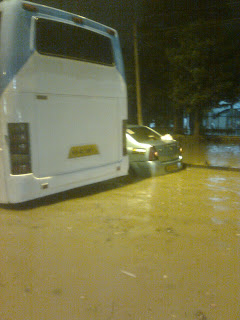
Here are some pics:

Thursday, September 9, 2010
Superfreakonomics
I had been wanting to write about this book for quite sometime now, given that I had read it almost a year ago. I had read Freakonomics, the first book by the authors Dubner and Levitt and loved it so much that I blindly ordered a copy of the sequel without even bothering to read the reviews. Perhaps it wasn’t such a wise decision after all.
The basic premise that the authors worked on in the original Freakonomics is “People respond to incentives”; whether it is a suicide bomber, a real estate agent, a drug dealer, a sumo wrestler or a street prostitute. Superfreakonomics was intended as a sequel with the same premise, based on which, the authors have aggregated a number of unrelated topics which are in reality no more than anecdotes, short stories if you will. Somewhere along the entire book, I never got the impression that “People respond to incentives”. Either the authors have completely digressed from the basic premise that they claim to be a unifying theme between both the books, or I have somehow failed to read between the lines.
The very first chapter that gives a detailed ‘analysis’ of the economics of prostitution, is not only quite crude and obnoxious, in my view, but also really tells us nothing significant or interesting. It looks as though the authors have deliberately thrust the chapter right in the beginning of the book in order to engage the reader enough so that he/she will end up reading the rest of the book; this of course is the popular trend these days and it works!
Then there is this other chapter that talks about how the brouhaha over global warming is uncalled for, with only a 5% probability of an actual catastrophe happening, and this number itself is uncertain as well. The authors further say that the issue of global warming has become a ‘religion’ where the true believers are going all out to reduce carbon emissions while the agnostics claim that human activity contributes just 2% of global CO2 emissions, the rest coming from natural processes like plant decay. Obviously, this kind of an assertion had to incur the wrath of the scientist community. A few other smaller stories are thrown in such as about how ‘global cooling’ and not ‘global warming’ was the major issue in the 1970s, and the impact of Mount Pinatubo’s volcanic eruption on the world climate.
Okay, fine. Now while I am still trying to figure out what on earth any of the above stories have to do with economics or have any meaningful data backing them, the authors shift gears. Enter “Intellectual Ventures (IV)” and its founder Mr. Nathan Myhrvold. The rest of the chapter (which is around 60-70%) is all about glorifying the ingenuity of Mr. Myhrvold and how he has found the ‘magical’ solution to the global warming problem at a very low cost – Inject sulfur dioxide into the stratosphere using a really high hose. The Sulfur dioxide, combined with the water vapor in the atmosphere, has the property of reflecting sunlight back into space. Voila! An alternative solution suggested by IV is to form man-made clouds that would induce a cooling effect in the atmosphere. And how is this done? Use a fleet of boats with underwater turbines to kick up a steady stream of water spray into the air, several yards above the ocean’s surface. Sounds simple enough?
And not just global warming, IV seems to have a solution to every other global problem. For e.g, a simple solution to avert hurricanes in future is to continually keep flushing out the warm surface water of oceans to the bottom, so that the colder water comes to the surface; and this can be done by using huge floating cylinders in the ocean!
The whole chapter was nothing more than a long winding epic story, phew!
Now that was about global warming. There was this other chapter on why suicide bombers should buy life insurance. This topic particularly caught my attention, as the chapter summary hinted at something like “How to catch a terrorist?” which made me quite curious. And instead what do I get? I get to know about some guy called Ian Horsley (“name changed for security reasons”) who mined a lot of data on the terrorists, and created an algorithm that would identify a terrorist with 99% accuracy. And what more, the most potent metric that truly made the algorithm work was “Variable X”, that cannot be disclosed “in the interest of national security”. What a bummer this was!
I do not want to sound overtly critical; the book was definitely engaging to a good extent and does provide good entertainment value. There are also several interesting facts and theories that I learnt from the book. And yeah, the epilogue section on the experiments with monkeys was quite hilarious. But still, on the whole, the book turned out to be far below my expectations and was simply not up to the high standards set by Freakonomics. several claims were either not so believable or were incomplete, and not so much backed by data while some were plain irresponsible. One can read it purely for the entertainment it provides, and not look for applications of economic heories in day-to-day life, unlike Freakonomics which stuck to its theme pretty much.